
Stenner products come in a dizzying number of configurations. To alleviate confusion and to streamline the learning and buying process, we offer the following pre-determined configurations. These aren't random - these configurations represent 90% of the systems that are sold because they cover the broadest range of applications:
Stenner single-head fixed rate pumps
These pumps are just as they sound - a single pump head that is capable of moving a fixed volume of liquid:
45MFL5A3S - 50 GPD / Low Pressure / 3/8" Tubing / 120V 45MFL3A3S - 22 GPD / Low Pressure / 3/8" Tubing / 120V 45MFL3A1S - 22 GPD / Low Pressure / 1/4" Tubing / 120V 45MFH1A1S - 3.0 GPD / High Pressure / 1/4" Tubing / 120V
Stenner single-head adjustable rate pumps
These pumps are also a single-head pump, but they have an adjustable feed rate that is user-controlled. They're a little more expensive but offer the fine-tuning that can really help you to dial in just the right amount of chemical:
85MJH2A3S - 0.8-17.0 gallons GPD / High Pressure / 120V / 3/8" Tubing 85MJH1A1S - 0.3-5.0 gallons GPD / High Pressure / 120V / 1/4" Tubing 45MJH2A3S - 0.3-5.0 gallons GPD / High Pressure / 120V / 3/8" Tubing 45MJH2A1S - 0.5-10.0 gallons GPD / High Pressure / 120V / 1/4" Tubing 45MJH1B1S - 0.2-3.0 gallons GPD / High Pressure / 220V / 1/4" Tubing 45MJH1A1S - 0.2-3.0 gallons GPD / High Pressure / 120V / 1/4" Tubing
Understanding Stenner pump part numbers
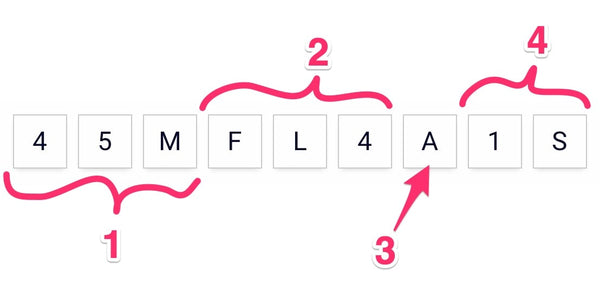
Because Stenner chemical feed pumps are available with so many different options they have a convention for how each pump is named. Once you understand the naming convention, it's actually quite easy to understand the features of each pump. Here's a diagram that uses an example to break down what each part of the Stenner pump part number means:
1. Pump series
These first three digits refer to the series that the pump belongs to.
2. Fixed rate / adjustable + flow capacity
The first two characters in the this region tell you if the pump is an adjustable rate (JL) pump or a fixed rate (FL) pump. The single digit that follows gives the flow capacity for the pump. Higher numbers correspond to a higher flow capacity.
3. Pump operating Voltage
A = 120V / 60Hz B = 120V / 60Hz C = 230V / 50Hz - International D = 250V / 50Hz - International
3. Tubing type & size
1 = 1/4" White 2 = 1/4" UV Black 3 = 3/8" White 4 = 3/8" UV Black
3. Tubing material type
S = Santoprene® T = Versilon®
Applications for Stenner chemical feed pumps
Stenner pumps are used to move liquid chemicals from one location to another. The peristaltic action of the pump head creates both suction in the feed tube and significant positive pressure in the output. This make Stenner pumps self-priming and also capable of being used to inject chemicals in to a pressurized line. This make them highly versatile and able to be used in many water treatment applications. The most common are outlined here:
1. Chlorinator / chlorine pump for well water
Using a Stenner pump to inject chlorine into a pressurized water line is very likely the most common application for these versatile pumps. Chlorine is pumped into a water line for many different reasons. It can be used as a chemical oxidizer to help with the filtration of iron, sulphur, and manganese or it can help to oxidize and break apart large organic molecules (like tannin or lignin). Using a Stenner pump to inject chlorine can also be used to disinfect water: that is, to destroy pathogenic organisms like bacteria and viruses. In these applications the pump is often generically referred to as the "chlorinator". The feed end of the tube is immersed in the chlorine solution and the output end of the line is attached to the water line. When injecting into a pressurized line (every home water line is pressurized) a one-way valve typically called a "duck bill" is used. This allows chlorine to be pumped in and prevents water from moving the other direction into the feed tube. In these applications, it's important that a Stenner "high pressure" model is used.
2. Peroxide injection
Peroxide is another oxidizing agent but one that has a few advantages over chlorine: it's much more aggressive, and any excess peroxide that's added breaks down quickly into water. Peroxide is used in pretty much every application that chlorine is used in and is overtaking chlorine as the preferred oxidative agent for the reasons above. One unique application where peroxide is used with a Stenner pump is in the deep well injection of peroxide into wells. In this application, rather than using the Stenner pump to feed the chemical into the water line, it's used instead to inject the chemical directly into the well. This gives the advantage of increased contact time. That is, the injected peroxide has more time to do its work and for excess peroxide to break down into harmless water. For deep well peroxide injection, a low pressure Stenner pump will do the job, but if you're injecting chlorine into a pressurized a line a high pressure Stenner pump will be required.
3. pH boosting / pH correction
The Stenner pump product line is often used a feeder for pH correcting chemicals. In the residential market, this is almost always an application where the pH is very low and pH boosting chemical is pumped into the water line to bring the ph to neutral or just above. In residential water, pH that is acidic (below 7) can harm plumbing, metallic fixtures, and can interfere with other water treatment processes.
Stenner pump maintenance & parts
Stenner pumps are well made and exceptionally durable, but every piece of water treatment equipment with moving parts will eventually need some form of maintenance and may eventually require some warn-out parts to be replaced. Stenner understands this and offers some service kits to allow for easy servicing of the most common components for their most common pumps. Pump tubes are offered in 5-packs as they're the most commonly replaced component. The replacement pump tube packs also come with replacement ferrules.
Stenner service kits
FSK100 - Classic Series Feed Rate Service Kit GSK45A - Classic Series Gear Case Service Kit MSK120 - Classic Series Motor Service Kit (120V
Stenner Replacement Pump Tubes
MCCP201 - #1 Replacement Pump Tube (5-pack) MCCP202 - #2 Replacement Pump Tube (5-pack) MCCP203 - #3 Replacement Pump Tube (5-pack) MCCP204 - #4 Replacement Pump Tube (5-pack) MCCP205 - #5 Replacement Pump Tube (5-pack) MCCP207 - #7 Replacement Pump Tube (5-pack)